[cryout-multi][cryout-column width=”1/2″]
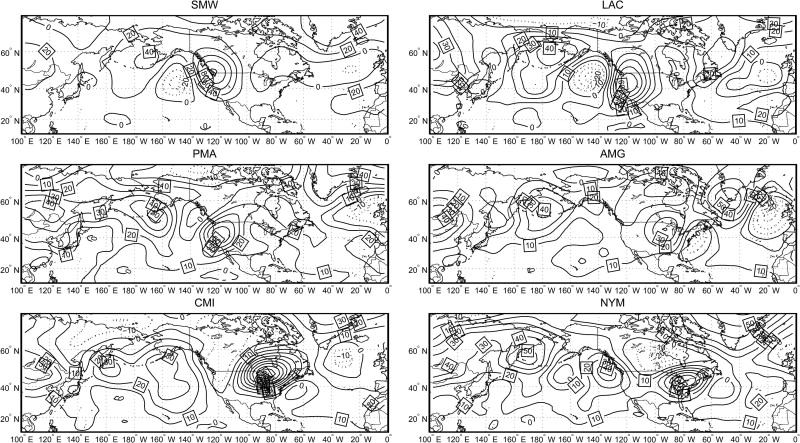
[/cryout-column] [cryout-column width=”1/2″]Development of regulatory strategies for state-wide attainment of air quality standards for ozone and particulate matter (PM) requires a full understanding of the chemical and physical dynamics of tropospheric ozone. Air Quality Models (AQMs) are powerful tools for the investigation of ozone buildup mechanisms, however, due to the complexity and geographic specificity of such models, they can only be used to simulate a limited number of episodes. Meteorological conditions have a large impact on air quality, and selection of representative scenarios under which air quality standards are exceeded is critical to maximizing the knowledge gained from AQM simulations. We use cluster analysis to determine recurring meteorological states using historical data. Categorization of days of the ozone (or PM) season to meteorological regimes permits identification of representative atmospheric conditions favorable to ozone (or PM) buildup. [/cryout-column] [/cryout-multi]
Our collaborator in this project is Professor Wei Sun (BUCT).
Related Publications
- Sun, W., A. Palazoglu, A. Singh, H. Zhang, Q. Wang, Z. Zhao, D. Cao, “Prediction of Surface Ozone Episodes Using Clusters Based Generalized Linear Mixed Effects Models in Houston-Galveston-Brazoria Area, Texas,” Atmospheric Pollution Research, in press (2015).
- Zhang, H., A. Palazoglu, W. Sun, Z. Zhao, S. Liu, “Prediction of Surface Ozone Exceedance Days Using PCA with Non-parametric T2 Control Limit,” Chemometrics and Intelligent Laboratory Systems, 133, 42-48 (2014).
- Sun, W., H. Zhang, A. Palazoglu, “Prediction of 8hr-average Ozone Concentration Using a Supervised Hidden Markov Model Combined with Generalized Linear Models,” Atmospheric Environment, 81, 199-208 (2013).
- Sun, W., H. Zhang, A. Palazoglu, A. Singh, W. Zhang, S. Liu, “Prediction of 24-hour-average PM2.5 Concentration using a Hidden Markov Model with Different Emission Distributions in Northern California,” Science of the Total Environment, 443, 93-103 (2013).
- Zhang, H., W. Zhang, A. Palazoglu and W. Sun, “Prediction of Ozone Levels Using a Hidden Markov Model (HMM) with Gamma Distribution,” Atmospheric Environment, 62, 64-73 (2012).
- Singh, A. and, A. Palazoglu, “Climatic Variability and its Influence on Ozone and PM Pollution in 6 Non-Attainment Regions in the United States,” Atmospheric Environment, 51, 212-224 (2012).
- Singh, A. and A. Palazoglu, “A Statistical Framework to Identify the Influence of Large Scale Weather Events on Regional Air Pollution,” J. Applied Meteorology and Climatology, 50(12), 2376-2393 (2011).
- Beaver, S., S. Tanrikulu, A. Palazoglu, A. Singh, S. Soong, Y. Jia, C. Tran, B. Ainsle, D. Steyn, “Pattern-Based Evaluation of Coupled Meteorological and Air Quality Models,” J. Applied Meteorology and Climatology, 49(10), 2077-2091 (2010).
- Beaver, S., A. Palazoglu, A. Singh, S-T Soong, and S. Tanrikulu, “Identification of Weather Patterns Impacting 24-hour Average Fine Particulate Matter Pollution,” Atmospheric Environment, 44(14),
- Beaver, S., and A. Palazoglu, “Influence of Synoptic and Mesoscale Meteorology on Ozone Pollution Potential for San Joaquin Valley of California,” Atmospheric Environment, 43, 1779-1788 (2009).
- Pakalapati, S., S. Beaver, A. Palazoglu, J.A. Romagnoli, “Sequencing Diurnal Air Flow Patterns for Ozone Exceedance Days around Houston, Texas” Atmospheric Environment, 43, 715-723 (2009)
- Beaver, S., and A. Palazoglu, “Hourly Surface Wind Monitor Consistency Checking over an Extended Observation Period,” Environmetrics, 20, 399-415 (2009)
- Beaver, S., S. Tanrikulu, and A. Palazoglu, “Cluster Sequencing to Analyze Synoptic Transitions Affecting Regional Ozone,” J. Applied Meteorology and Climatology, 47(3), 901-916 (2008).
- Beaver, S. and A. Palazoglu, “A Cluster Aggregation Scheme for Ozone Episode Selection in the San Francisco, CA Bay Area,” Atmospheric Environment, 40, 713-725 (2006).
- Beaver, S. and A. Palazoglu, “Cluster Analysis of Hourly Wind Measurements to Reveal Synoptic Regimes Affecting Air Quality,” J. Applied Meteorology and Climatology, 45(12), 1710–1726 (2006).